
The Nativity of the Blessed Virgin Mary
Feast Day: September 8

First Reading: Micah 5:1-4a; alternate Romans 8:28-30
Responsorial Psalm: Psalm 13
Gospel: Matthew 1:1-16, 18-23
Key Theme: God’s saving plan
Focus: Trust
Summary: God prepares the way for Jesus through Mary. Jesus comes to save his people and bring peace.
Challenge: Trust God when the future is unclear. Follow Mary and Joseph by responding with faith.
Action Step: Pray one Hail Mary. Ask God for greater trust.
Verse to Remember: “I trust in your mercy” (Psalm 13)
The Feast of The Nativity of the Blessed Virgin Mary is celebrated each year on September 8th. This day marks the birth of Mary, who is honored as the mother of Jesus Christ. It is an important day for Catholics around the world. Many people use this day to reflect on Mary’s special role in the life of Jesus.

Mary’s birth is seen as a key moment in Christian history. Catholics believe that she was born without original sin, which made her the perfect choice to become the mother of Jesus. Because of this belief, the Church celebrates her birth with great respect. The Feast is a chance to remember how important Mary is to the story of Jesus.
The celebration of Mary’s birth has been part of Christian tradition for many centuries. By the 5th century, the Church had already recognized it as a special feast. Over the years, people have created different ways to mark the day, such as attending church services or participating in processions.
For many Catholics, this feast day is a time to pray and think about the meaning of Mary’s life. It is also a time to honor her through acts of kindness and reflection. The Feast of The Nativity of the Blessed Virgin Mary offers a moment each year to focus on Mary’s role in the Christian faith.
The Early Beginnings of the Feast
The Feast of The Nativity of the Blessed Virgin Mary has been celebrated for many centuries. It started in the early days of Christianity. Christians wanted to honor Mary because she played such an important role as the mother of Jesus. The first celebrations of Mary’s birth likely began in the Eastern part of the Roman Empire, where Christians already had a strong devotion to her.
The feast became more popular over time. By the 5th century, it had spread to other Christian communities. The Church in the West began to celebrate it as well, making it a part of the liturgical calendar. As it spread, more people began to see it as an important day to remember Mary’s birth and her role in the story of Jesus.
In the 5th century, the Church played a big part in making this feast more official. It was during this time that the celebration was formally recognized by the Catholic Church. Leaders in the Church saw how important Mary was to Christian faith and wanted to ensure that her birth was properly celebrated.
The date of September 8th was chosen as the official day for the feast. This date is believed to be connected to an older Christian tradition that celebrated the dedication of a church in Jerusalem. Over time, this day became more focused on honoring Mary’s birth itself, rather than just the church building.
As the feast became established, people found different ways to observe it. Church services, special prayers, and community gatherings became common ways to mark the day. It was a time for Christians to come together and reflect on the importance of Mary in their faith.
Today, the Feast of The Nativity of the Blessed Virgin Mary continues to be an important celebration in the Catholic Church. It has a long history, rooted in the early Christian tradition, and remains a key part of the Catholic calendar.
Mary’s Special Beginning and Her Role in God’s Plan
The Immaculate Conception is a key belief in the Catholic Church. It teaches that Mary was conceived without original sin. Original sin is the sin that all humans are said to inherit from Adam and Eve. But in Mary’s case, God gave her a special grace, allowing her to be born without it. This made her different from everyone else.
Mary’s birth without sin is very important because it prepared her for her role as the mother of Jesus. Catholics believe that because Mary was sinless, she was the perfect person to carry Jesus, who is seen as the Son of God. This belief helps explain why Mary is honored so much in the Catholic faith.
Mary’s role as the mother of Jesus makes her central to the plan of salvation in Christianity. Jesus is believed to be the one who saves people from sin, and Mary was chosen to bring Him into the world. Without Mary, Jesus would not have been born, so her part in the story is crucial.
Her birth is seen as the first step in preparing for the arrival of Jesus. By being born without sin, Mary was set apart for this special mission. Catholics see her birth as part of God’s plan to save humanity. It connects her directly to the story of Jesus and the salvation He brings.
In summary, Mary’s birth and her Immaculate Conception are key to understanding her role in Christian salvation. It all starts with her special beginning, which made her the ideal mother for Jesus. This is why her birth is celebrated so strongly in the Catholic Church today.
Celebrating the Feast in Catholic Worship
The Feast of The Nativity of the Blessed Virgin Mary is an important day in the Catholic Church. On this day, special Masses are held to honor Mary’s birth. These Masses focus on her role as the mother of Jesus and how her life connects to the story of salvation. During the Mass, prayers and readings remind the faithful of Mary’s importance.
The readings for the day are carefully chosen to highlight Mary’s significance. One common reading comes from the Gospel of Matthew, where the genealogy of Jesus is listed. This shows how Mary is connected to the line of David, fulfilling an important prophecy about the Messiah’s birth. Another reading may focus on how Mary accepted her role as the mother of Jesus with faith and trust.
In addition to Mass, many people choose to spend extra time in prayer on this day. Some may say the Rosary, a prayer that focuses on the life of Jesus and Mary. Others may participate in special devotions or attend processions dedicated to Mary. These acts of devotion help the faithful feel closer to Mary and remember her importance in their spiritual lives.
Overall, the Feast of The Nativity of the Blessed Virgin Mary is observed with a focus on prayer, reflection, and community worship. It is a time for Catholics to honor Mary’s birth and her role as the mother of Jesus through special prayers, readings, and hymns.
Celebrating Mary’s Birth Around the World
The Feast of The Nativity of the Blessed Virgin Mary is celebrated in many different ways around the world. One common way people honor Mary on this day is through Marian processions. In these processions, people walk together in prayer, often carrying statues or images of Mary. They sing hymns and say prayers as they go. These processions are a way to show devotion to Mary and celebrate her birth.
In some countries, special devotions are held on this day. For example, in Italy and Spain, it is common for communities to gather in churches to pray the Rosary together. The Rosary is a prayer that reflects on the lives of Jesus and Mary, and it is often a central part of the feast day. These gatherings bring people together in prayer and reflection.
In the Philippines, the feast is celebrated with a strong sense of community. Many churches hold special Masses and processions. People also decorate their homes with images of Mary, and some families host small celebrations to mark the day. These customs show how important Mary is to Filipino Catholics.
In Latin America, especially in Mexico, people celebrate the feast with music and festivities. Church bells ring, and families gather to attend Mass and share meals. In some areas, fireworks are even part of the celebration. These lively customs make the day feel like a joyful occasion, centered on honoring Mary.
In France, the feast is often marked by quiet, reflective gatherings in churches. Many people spend time in prayer, lighting candles in front of statues of Mary. This simple but meaningful act helps people feel connected to Mary’s life and her role as the mother of Jesus.
Around the world, the Feast of The Nativity of the Blessed Virgin Mary is celebrated in many ways, from large processions to quiet prayers. Each tradition highlights a deep respect and love for Mary, making the day a special part of Catholic life everywhere.
Reflecting on Mary’s Life and Virtues
The Feast of The Nativity of the Blessed Virgin Mary is not just a time to celebrate her birth, but also a chance to think about her life and virtues. Catholics are encouraged to reflect on Mary’s example of faith, humility, and obedience. Mary is seen as someone who trusted in God’s plan completely, even when it was difficult. Her life serves as a model for how to live with faith and trust in God.
One way people can reflect on Mary’s virtues is by spending time in quiet prayer. Praying the Rosary is a common way to meditate on Mary’s life, as each set of prayers focuses on important events in her life and the life of Jesus. This can help the faithful think more deeply about how Mary’s trust in God can inspire their own faith.
Another way to honor Mary on her feast day is through acts of kindness. Catholics are encouraged to perform charitable acts in her honor. This can be as simple as helping a neighbor, visiting someone who is lonely, or donating to those in need. By showing kindness to others, Catholics can imitate the love and compassion that Mary showed throughout her life.
In addition to personal reflection, many communities come together for special prayers or devotions. These gatherings offer an opportunity to pray as a group and reflect on Mary’s role in the Church. Some churches hold prayer vigils or special services where the faithful can join together to honor Mary and ask for her intercession.
For those who want to take part in community actions, organizing or attending a Marian procession can be a meaningful way to show devotion. Walking together in prayer, singing hymns, and reflecting on Mary’s life can bring a sense of unity and shared faith. This also helps to strengthen the bond within the community as they honor Mary together.
Whether through personal prayer, acts of kindness, or community gatherings, the Feast of The Nativity of the Blessed Virgin Mary is a day to reflect on her life and the virtues she represents. Catholics are encouraged to follow her example and grow in faith, trust, and love.
Daily Mass Readings for the Feast of the Nativity of the Blessed Virgin Mary
- First Reading – Micah 5:1-4A: The Lord says a ruler will come from tiny Bethlehem, ancient in origin. After a period of hardship, this leader will shepherd Israel, drawing strength from God. His influence will be global, and he will bring peace.
- Alternate First Reading – Romans 8:28-30: For those who love God, everything works out for good. God has predestined, called, justified, and glorified certain individuals to conform to the image of his Son, making them part of a larger spiritual family.
- Responsorial Psalm – Psalm 13: I trust in your mercy and find joy in your salvation. Singing praises, I acknowledge the Lord’s goodness to me.
- Gospel – Matthew 1:1-16, 18-23: Mary is pregnant through the Holy Spirit while betrothed to Joseph. Joseph plans a quiet divorce but an angel tells him the child is divinely conceived and will save people from sins. This fulfills a prophecy, naming the child Emmanuel.
Homilies, Reflections, and Commentaries
- Prepared With Grace (Order of Preachers)
- Drawn towards mercy (Pray as You Go)
- The Grace to Be Small (Jesuits)
- Someone’s Baby (Catholic Women Reflect)
- Learning from Mary’s Life and Example (Reflection and Questions)
- More Homilies, Reflections, and Commentaries for the Nativity of the Blessed Virgin Mary
Prepared With Grace
God often prepares something important through people and places that seem small or ordinary. Sister Rose Rochoya says Mary’s life shows how God works quietly over time, shaping people through grace even when they cannot yet see the full plan.
She invites us to ask where God may be preparing something within us and whether we are willing to stay humble, faithful, and open to his direction. On the Nativity of the Blessed Virgin Mary, Sister Rose encourages trust that God can work through our smallness and bring good from lives surrendered to him.
Drawn towards mercy
Where is God asking you to trust him without having every answer? Pray As You Go focuses on Matthew 1:18–23 and Joseph’s response to Mary’s unexpected pregnancy. The prayer notices that Joseph leans toward mercy even before he understands what God is doing, choosing compassion instead of public shame.
The reflection also points to Joseph’s quiet trust when the angel speaks to him in a dream. God meets him at a moment when he cannot control the situation or reason everything out. Pray As You Go invites us to notice where we may be facing a similar call to let go of control, choose mercy, and say yes to God even when the way ahead is unclear.
Featured music: “Ave Maria” by Margaret Rizza, performed by the Gaudete Ensemble
The Grace to Be Small
Wanting to be noticed, praised, or important can quietly shape the way we live. John Stein, SJ, reflects on Matthew 1:18–23 and the humility of Mary, who appears in the Gospel as someone small, vulnerable, and easily misunderstood rather than as a public hero.
Stein invites us to see this smallness as a spiritual gift. Mary does not need to be the center of attention for God to work through her, and Jesus himself chooses the smallness of the womb. The reflection encourages us to let go of the need for recognition and ask for the grace to become more humble, making more room for God and for others.
Someone’s Baby
Every human life begins small, dependent, and full of possibilities we cannot yet see. Robyn looks at the Nativity of the Blessed Virgin Mary by remembering Mary first as a newborn child. Before her many titles and her place in salvation history, she needed to be held, fed, protected, and loved.
Robyn uses Mary’s birth to show how quietly God often begins his work. Grace can start in ordinary moments, hidden from notice. Her life also reminds us not to dismiss people whose importance is not obvious. We belong to one another, and vulnerability is part of being human. Mary’s beginning invites us to stay open to the new ways God may still be working in our lives.
Learning from Mary’s Life and Example
The Feast of The Nativity of the Blessed Virgin Mary is a special time to think about the life of Mary and how it connects to our own lives. Mary was chosen for a unique role, but she was also a person who lived with faith, trust, and love. She faced challenges and uncertainties, just like we do. Her life shows us how to respond to life’s difficulties with courage and faith in God’s plan.
One of the key lessons from Mary’s life is her willingness to say “yes” to God. Even when she didn’t fully understand what her future would hold, she trusted that God would guide her. We can take inspiration from this and remember that sometimes, we may not know what lies ahead, but we can trust that things will work out if we stay faithful.
Mary’s humility is also an important part of her story. She didn’t seek attention or praise, but quietly accepted her role. In a world where people often seek recognition and success, Mary reminds us that true greatness comes from serving others and being faithful to our responsibilities. We can learn from her example to live with humility and focus on what really matters.
Finally, Mary’s love and care for others are qualities we can all strive to have in our own lives. She cared for Jesus and supported those around her with compassion. Whether it’s helping a family member, a friend, or even a stranger, we can reflect on how we show love in our daily lives and how we can do more to care for others.
Reflection Questions
- How can you practice showing more love and care to those around you?
- How can you show more trust in your daily life, like Mary did?
- In what ways can you live with more humility and focus on serving others?
More Homilies, Reflections, and Commentaries for the Nativity of the Blessed Virgin Mary
- Born Into Eternal Life (Order of Preachers: Fr. Euan Marley)
- No Place for Shame (Dynamic Catholic: Matthew Kelly)
- Mary’s Multifaceted Roles (Word on Fire: Bishop Robert Barron)
- God Is Still Working in Our Story (USCCB: Dcn. Arthur Miller)
- Hope in Our Family Story (USCCB: Msgr. James Vlaun)
- Genealogy, Mary’s Yes, and Suffering (USCCB: Fr. John Mckenzie)
Resources for the Feast of the Nativity of the Blessed Virgin Mary

Fiat: Lesson Plan on Mary’s Let It Be Done
The Feast of The Nativity of the Blessed Virgin Mary, celebrated on September 8th annually, is a day of prayer and reflection. It provides an opportunity to contemplate Mary’s integral role in Christian salvation. This reflection focuses on Mary’s “Let it be done to me” (fiat) and is tailored for youth.
The lesson plan incorporates small group discussion questions to encourage thoughtful exploration of Mary’s significance in the faith.

Why Do Catholics Pray to Mary and the Saints? A Lesson Plan
The Feast of The Nativity of the Blessed Virgin Mary is a day for prayer and reflection, inviting a deeper understanding of Mary’s role in Christian salvation. Individuals often honor Mary through charitable acts and personal contemplation.
The lesson plan tackles the question of why Catholics pray to Mary and the saints, likening it to asking a friend for prayers. It emphasizes the distinction between prayer and worship, helping youth grasp this aspect of Catholic tradition.

Psalm 132: Hope and Faithfulness
Psalm 132 tells the story of King David’s desire to honor God by bringing the Ark of the Covenant to Jerusalem. The Ark was a sacred chest that represented God’s presence with His people. David wanted to create a permanent place for worship in Jerusalem.
Mary is called the new Ark of the Covenant because she carried Jesus, God’s son, in her womb. Just as the Ark held God’s presence in the Old Testament, Mary brought God’s presence to the world through Jesus.
Social Media Graphics and Bulletin Artwork
Joyful Beginning: The Nativity of Mary

Celebrate the birth of the Blessed Virgin Mary with this beautiful artwork of Saints Joachim and Anne holding their newborn daughter. Ideal for prayer spaces, teaching environments, and family rooms, it is available as posters, cards, canvas prints, home décor, and more. A digital download option offers instant access for sharing and displaying this tender moment anywhere.
Click on the image for more information on how to get the full sized artwork.
Paid subscribers may download this file without watermarks for use in bulletins, social media, newsletters, etc. You must be logged in as a paid subscriber to access the file.
Only current paid subscribers have the rights to use the artwork.
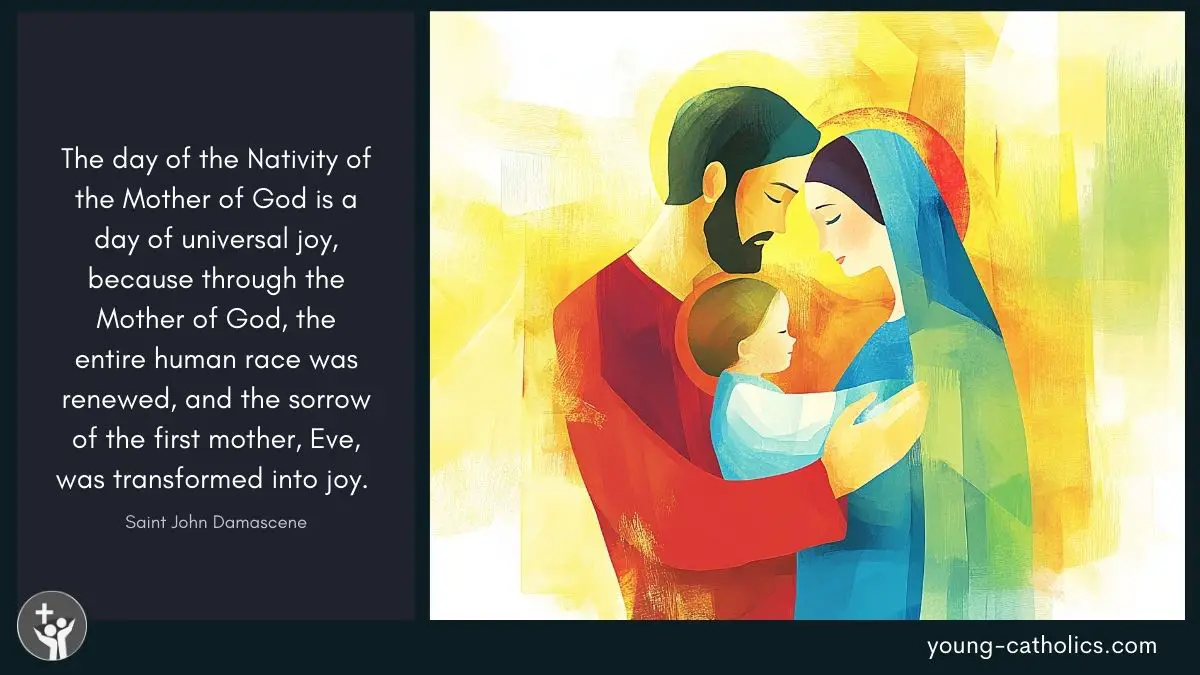
Questions and Answers for the Feast of the Nativity of the Blessed Virgin Mary
What is the Feast of The Nativity of the Blessed Virgin Mary?
The Feast of The Nativity of the Blessed Virgin Mary is a celebration of Mary’s birth. It is held on September 8th every year.
Why is the Feast of The Nativity of the Blessed Virgin Mary important?
This feast is important because Mary was chosen to be the mother of Jesus. Her birth is seen as a key moment in Christian history.
How is the Feast of The Nativity of the Blessed Virgin Mary celebrated?
The feast is celebrated with special Masses, prayers, hymns, and sometimes processions. People often reflect on Mary’s life and virtues.
Why is September 8th the date for the Feast of The Nativity of the Blessed Virgin Mary?
September 8th was chosen because it was connected to an old tradition in the early Church. Over time, it became the official date to honor Mary’s birth.
What is the meaning of the Feast of The Nativity of the Blessed Virgin Mary?
The feast celebrates the birth of Mary and recognizes her special role as the mother of Jesus. It is a day to honor her life and example.
Is the Feast of The Nativity of the Blessed Virgin Mary a holy day of obligation?
The Feast of The Nativity of the Blessed Virgin Mary is not a holy day of obligation, but it is still an important celebration for Catholics.
How can I observe the Feast of The Nativity of the Blessed Virgin Mary at home?
You can observe the feast by praying the Rosary, reading about Mary, and reflecting on her life. Some people also light a candle in her honor.
What is the connection between the Feast of The Nativity of the Blessed Virgin Mary and Christian salvation?
The feast highlights Mary’s role in the plan of salvation, as she was chosen to be the mother of Jesus. Her birth prepared the way for Jesus to come into the world.
What are the Mass readings for the Feast of the Nativity of the Blessed Virgin Mary?
First Reading – Micah 5:1-4A: Bethlehem’s Promise
Alternate First Reading – Romans 8:28-30: Predestined Purpose
Responsorial Psalm – Psalm 13: Rejoicing in Salvation
Gospel – Matthew 1:1-16, 18-23: Jesus’ Birth Explained
An Example of Living Faith
The Feast of The Nativity of the Blessed Virgin Mary is a special day in the Catholic Church. It celebrates the birth of Mary, the mother of Jesus, and is observed on September 8th each year. This feast is important because Mary’s birth is seen as a key part of God’s plan. Catholics believe that Mary was born without original sin, which made her the perfect person to become the mother of Jesus.
The celebration of this feast has been part of Christian tradition for centuries. It began in the early Church, especially in the East, and spread to other Christian communities by the 5th century. The Catholic Church officially made it a part of the liturgical calendar, with September 8th chosen as the date. Today, Catholics celebrate the day with special Masses, prayers, and hymns.
Many people observe the Feast of The Nativity of the Blessed Virgin Mary by praying the Rosary, attending Mass, or participating in Marian processions. It is a day for reflection on Mary’s life and virtues, such as her humility, faith, and love. The feast reminds Catholics of Mary’s important role as the mother of Jesus and her example of living a life of trust in God.
Your Turn
Learn more about the Feast of The Nativity of the Blessed Virgin Mary and how it is celebrated around the world. Take time to reflect on the life and virtues of Mary, and how her example can inspire you in your own life.
You are invited to share your thoughts and experiences about this feast day in the comments section. How do you honor Mary on this day? Let’s start a conversation and learn from each other.
Leave a Reply