
The Immaculate Conception of the Blessed Virgin Mary
December 8

First Reading: Genesis 3:9-15, 20
Responsorial Psalm: Psalm 98
Second Reading: Ephesians 1:3-6, 11-12
Gospel: Luke 1:26-38
Key Theme: Chosen by God
Focus: Mary’s faithful yes
Summary: God prepared Mary for her special role in salvation. Mary trusted God and accepted His plan with humility.
Challenge: Trust God when His plans seem difficult or unclear. Follow Mary’s example by listening and responding with faith.
Action Step: Pray one Hail Mary. Ask God for courage to say yes to His will.
Verse to Remember: “May it be done to me according to your word.” (Luke 1:38)
Mary is the mother of Jesus. She is a central figure in the Catholic faith. Catholics believe that God chose her to be the mother of His Son. This makes her very special.

The Immaculate Conception is a teaching about Mary. It means that Mary was free from original sin from the moment she was conceived. This teaching shows that God prepared Mary to be a pure vessel for Jesus.
Catholics celebrate the Feast of the Immaculate Conception on December 8th. This day honors Mary’s sinless beginning. It reminds us of God’s special plan for her.
Mary is also known for her role as a loving mother. She cares for us and prays for us. Many Catholics ask for her help and guidance. She is a powerful example of faith and obedience to God.
The Doctrine of the Immaculate Conception
The doctrine of the Immaculate Conception is about Mary. It teaches that she was free from original sin from her very beginning. This is a special grace from God.
Original sin is the sin that everyone is born with. It comes from Adam and Eve. But God kept Mary free from this sin. He did this because she was going to be the mother of Jesus.
The Church teaches that this grace was given to Mary at the moment of her conception. This means from the very first moment of her life, she was without sin. This is why it is called the Immaculate Conception.
Pope Pius IX declared this teaching in 1854. He said it was a part of the faith that had always been believed. He made it official in a document called Ineffabilis Deus.
The Bible supports this teaching in several ways. One example is the angel Gabriel calling Mary “full of grace” when he visits her. This greeting shows her special place and purity.
Saints and Church fathers have also spoken about Mary’s purity. Saint Augustine and Saint Thomas Aquinas both wrote about her being free from sin. They believed that Mary needed to be pure to be the mother of Jesus.
Catholics celebrate the Immaculate Conception on December 8th. This feast day reminds us of God’s special plan for Mary. It is a day to honor her and thank God for her purity.
The Immaculate Conception also teaches us about God’s power and mercy. It shows how God prepared Mary for her role in salvation. This doctrine helps us understand the importance of Mary in our faith.
Mary’s purity and obedience to God make her a model for us. We can look to her as an example of how to live our lives. She shows us how to say yes to God’s will.
Mary’s Role in Salvation History
Mary’s role is deeply connected to Jesus’ mission. She is called the new Eve. This title shows her importance in redemption. Just as Eve played a part in mankind’s fall, Mary played a part in our salvation.
Eve’s disobedience led to the fall of mankind. She did not follow God’s command. In contrast, Mary’s purity and obedience played a vital role in salvation. She followed God’s will perfectly.
The Immaculate Conception means Mary was free from original sin. This special grace made her the perfect vessel for Jesus. Her purity set her apart from all others.
The angel Gabriel announced that Mary would bear the Son of God. This event is called the Annunciation. Mary responded with complete trust and surrender to God’s plan.
Mary’s “Yes” at the Annunciation is called her fiat. Her agreement allowed the Incarnation to take place. This shows the importance of human cooperation in God’s plan. Without her “Yes,” the world would not have received Jesus.
Mary’s role as Jesus’ mother is central to her mission. She nurtured and cared for Him. Her faith and obedience make her a model for all Christians. She always followed God’s will.
Mary’s example inspires believers to trust in God’s plan. Her life is a guide for us. She encourages us to say “Yes” to God’s will, just as she did. Her trust in God was complete.
As the new Eve, Mary reversed the disobedience of the first Eve. Her purity and obedience brought salvation. She played a vital role in God’s plan.
Mary’s role is multifaceted: new Eve, pure vessel, and obedient servant. Each aspect of her life teaches us something important. Her example helps believers follow God’s will in their own lives. We look to her for inspiration and guidance.
Mary’s role in salvation history is unique and important. She is a central figure in our faith. Her life of purity and obedience is an example for all of us to follow.
Mary as a Model for Christians
Mary’s virtues of humility, obedience, and faith inspire Christians. Her example guides us in our daily lives. By looking at her life, we learn how to live better.
Mary’s humility is seen in her response to the angel Gabriel. She accepts God’s plan to become the mother of Jesus. This teaches us to recognize our limitations and submit to God’s will. Humility helps us rely on God.
Mary’s obedience is shown in her response to the angel’s message. She says, “Let it be done to me according to your word.” This teaches us to surrender to God’s commands and trust His plan. Obedience means following God’s guidance.
Mary’s unwavering belief in God’s promises is a key virtue. Her trust in God is evident from the Annunciation to the cross. This inspires us to deepen our own faith. Faith helps us trust God in all things.
By imitating Mary’s virtues, we can strive for a closer union with Christ. Her example shows us how to live a life of holiness and devotion. Living like Mary brings us closer to Jesus.
Mary leads us to Jesus through her example. She teaches us to follow Him with love and dedication. Her life points the way to Jesus. Following her example helps us follow Jesus better.
Humility in daily life means recognizing our own limitations. We must submit ourselves to God’s will, following Mary’s example. This helps us grow in our relationship with God. Humility keeps us grounded.
Obedience in daily life means being obedient to God’s word. We must follow His guidance in all aspects of our lives. This brings us peace and direction. Obedience helps us live rightly.
Faith in daily life means trusting in God’s promises. We must deepen our faith by following Mary’s example of unwavering belief. This strengthens our relationship with God. Faith gives us hope and confidence.
Mary’s virtues make her a model for Christians. By imitating her, we grow closer to Christ and deepen our relationship with Him. Her example serves as a guide to live a life of holiness and devotion to God. Living like Mary brings us joy and peace.
Patron Saint of …
The Immaculate Conception is the patroness of the United States.
Daily Mass Readings
- First Reading – Genesis 3:9-15, 20: After Adam and Eve eat the forbidden fruit, God confronts them. Adam blames Eve, who blames the serpent. God curses the serpent and sets enmity between it and humankind.
- Responsorial Psalm – Psalm 98: Sing a new song for the Lord’s marvelous deeds and victory. He has shown His salvation and justice to all nations, faithfully remembering His promise to Israel.
- Second Reading – Ephesians 1:3-6, 11-12: God, the Father of Jesus Christ, blesses us with spiritual gifts and chooses us for holiness and adoption through Jesus, fulfilling His will and glorifying His grace.
- Gospel – Luke 1:26-38: The angel Gabriel announced to Mary in Nazareth her divine selection to bear Jesus, the Son of the Most High. Initially troubled, Mary questioned how, being a virgin. Gabriel assured her of the Holy Spirit’s role and cited Elizabeth’s miraculous pregnancy as proof of God’s power. Mary humbly accepted her role, expressing obedience to God’s will.
Homilies, Commentaries, and Reflections the Immaculate Conception of the Blessed Virgin Mary
- This Present Moment (Fr. Mike Schmitz)
- Freedom from Sin (Order of Preachers)
- The Lord Is With You (Pray As You Go)
- Let It Be In God’s Hands (Jesuits)
- Nothing is Impossible (Dynamic Catholic)
- Mary And The Freedom To Say Yes (Word on Fire)
- Cosmic Hope (Center for Action and Contemplation)
- Opening The Angel’s Message (USCCB)
- More Homilies and Reflections the Immaculate Conception of the Blessed Virgin Mary
This Present Moment
Fr. Mike Schmitz reflects on the Immaculate Conception by explaining that God prepared Mary from the first moment of her life with a special grace that kept her free from original sin. He says this can seem abstract, but it speaks deeply to the call to live in the present moment. Mary shows that holiness begins with God’s initiative, yet it unfolds in real life through a willing heart. Her yes reverses the harm caused by Eve’s yes to deception, and it opens the way for Christ to enter a broken world.
Fr. Mike Schmitz also stresses that this feast is not only about Mary. It is God’s promise that sin does not have the final word. He reminds us that grace is stronger than weakness and is given to us through baptism, confession, and the Eucharist. God prepares, restores, and invites, but we must respond. The Immaculate Conception becomes a sign that holiness is possible and that God’s grace is already at work, waiting for our yes.
Freedom from Sin
Fr. Richard Ounsworth reflects on the Immaculate Conception of the Blessed Virgin Mary by clearing up the common misunderstanding that it refers to the conception of Jesus. He explains that the feast celebrates how Mary was preserved from original sin so she could live in a free and trusting relationship with God. This grace restored to her what humanity had lost, allowing her heart to be open and ready to welcome God’s word.
Fr. Ounsworth also reminds listeners that Mary’s yes was made possible by God’s action, not her own merit. He says people sometimes wish they had such clear help, yet they do. The crucified Christ stands as the sign and the power that restores each person through baptism. He teaches that the same grace that prepared Mary continues to work in believers, helping them say yes to God in their own lives with renewed trust and freedom.
The Lord Is With You
Pray As You Go offers a gentle reflection for the Immaculate Conception, using the reading from Luke 1:26-38. It invites the listener to sit with Mary as she meets the angel Gabriel. The reflection looks at her freedom to say yes and the grace that makes that possible. It asks the listener to notice Mary’s calm courage and the promise that nothing is impossible for God.
The reflection also encourages the listener to enter the scene with simple imagination. It asks where Mary might be, how she might feel, and how Gabriel might appear. These questions help the listener think about encounters with God in daily life. The Immaculate Conception is lifted up as a sign of God’s closeness, shown in Mary’s open heart and trusting response.
Music: L’espérance by The Brilliance and Musique de Noël instrumentale by Raphah
Let It Be In God’s Hands
Laura Gilmartin reflects on the Immaculate Conception by looking at Mary’s simple and trusting heart. She connects the words let it be to moments of struggle and to the gentle wisdom many people find in Mary. She notes that Mary was young and did not understand much about what God was asking, yet grace helped her listen and stay open. This grace is at the center of the Immaculate Conception and shows how God prepares us for what lies ahead.
Laura also points to the signs that helped Mary move toward her yes. The angel spoke of the Holy Spirit at work, of Elizabeth’s unexpected pregnancy, and of God’s power to do what seems impossible. These signs encouraged Mary to give her whole heart to God’s plan. Laura invites readers to ask for the same courage and trust in their own lives.
Nothing is Impossible
For the Immaculate Conception of the Blessed Virgin Mary, Matthew Kelly reflects on the angel’s message to Mary and invites listeners to notice one word or idea that speaks to them. He highlights how Mary finds favor with God and asks whether people ever stop to wonder what God thinks of their choices. He reminds readers that nothing is impossible for God and encourages them to name the places in their own lives that feel impossible.
Matthew Kelly also reflects on Mary’s surrender when she says, be it done according to your word. He asks where God may be inviting each person to surrender something that holds them back. He encourages a fresh openness to the Holy Spirit, noting how rarely people pause and ask for the Spirit’s guidance. He closes by saying one simple word or idea from the Gospel can shape the whole day and deepen a person’s trust in God.
Mary And The Freedom To Say Yes
Bishop Robert Barron reflects on the Immaculate Conception by showing Mary as the New Eve. Eve reached for control, but Mary welcomed God’s plan with a willing heart. Her words may it be done to me show a new way of living. They reveal the quiet strength of trusting God rather than holding tight to our own plans.
Bishop Barron explains that real freedom comes when we let God shape our lives. This surrender may feel hard, yet it brings peace because it frees the true self. The grace of the Immaculate Conception made Mary ready for this open trust. Bishop Barron invites us to share her posture and to welcome God with the same simple yes.
Cosmic Hope
In this reflection, Fr. Richard Rohr celebrates the Feast of the Immaculate Conception of Mary, drawing inspiration from St. Bonaventure’s Trinitarian vision of a universe intrinsically connected to God. Bonaventure saw reality as a journey from, with, and back to God, emphasizing a cosmic, positive perspective, and the unity of matter and spirit. He disregarded a reward/punishment framework, focusing instead on the wholeness of God’s creation.
Fr. Rohr highlights the Immaculate Conception as symbolizing this wholeness and unity from Mary’s conception. He comments on the loss of such hopeful, expansive understanding of God in modern times, contrasting it with Bonaventure’s grand, benevolent cosmos and a God who is love itself, flowing through all creation.
Opening The Angel’s Message
Msgr. Vlaun reflects on the Immaculate Conception by inviting us to see the Annunciation as a kind of Advent card from the Church. He points to the angel’s words be not afraid and reminds us that we live under God’s mercy and care. He says this feast encourages us to trust that we are loved and called to holiness even in anxious times.
He also highlights Mary’s faith. Her belief that nothing is impossible with God becomes a steady hope for anyone facing questions or worry. Msgr. Vlaun notes that Mary’s yes shows a heart open to God’s will. He encourages us to let that same trust grow in our own lives. The Immaculate Conception and Advent come together to guide us toward a simple prayer that echoes Mary’s own words: let God’s will be done.
More Homilies and Reflections the Immaculate Conception of the Blessed Virgin Mary
In The Mind of God (Order of Preachers)
The Power of Mary’s Question (Dynamic Catholic)
Resources

Why Do Catholics Pray to Mary and the Saints? A Lesson Plan
The concept of the Immaculate Conception, which refers to Mary being conceived without original sin, is deeply rooted in the Catholic tradition of venerating Mary for her unique role in salvation history.
This lesson plan discusses the theological basis for praying to Mary and the Saints, emphasizing Mary’s unique relationship with Jesus. Moreover, the lesson plan draws a parallel between Mary and the queens in Jewish tradition, who held significant advisory roles to the kings. Mary, as the mother of Jesus, is seen as a spiritual queen, advocating for the people of God, much like the queens of the past advocated for their people.
This perspective highlights Mary’s special sanctity and her pivotal role in the divine plan of salvation.

The Blessed Virgin Mary
The Blessed Virgin Mary is honored as the Mother of God, the Mother of the Church, and the New Eve. Her faith and obedience allowed Jesus, the Savior, to enter the world. From her “yes” at the Annunciation to her care for the Church, Mary shows perfect trust in God’s plan. Her many titles remind us that she continues to guide and pray for us, leading us closer to her Son.
The Solemnity of the Immaculate Conception celebrates that Mary was free from original sin from the moment she was conceived. God prepared her in this special way to be the pure vessel for Jesus. This feast reminds us that God’s grace can make us holy too. Like Mary, we are called to say “yes” to God and to bring His love into the world through faith, humility, and service.
Our Lady of Lourdes
The apparition of Our Lady of Lourdes to St. Bernadette in Lourdes, France, directly relates to the doctrine of the Immaculate Conception. During these apparitions, the Blessed Virgin Mary identified herself to St. Bernadette as the “Immaculate Conception,” a title affirming her conception free from original sin.
This revelation occurred shortly after Pope Pius IX officially proclaimed the dogma of the Immaculate Conception in 1854. Mary’s self-identification as the Immaculate Conception at Lourdes underscores her unique status and reinforces the Church’s teaching regarding her sinless conception.
Social Media Graphics and Bulletin Artwork
If you would like an image to be made available as a specific product (card, poster, mug, etc.) or as an extra high resolution image for personal use just post a comment about what you want and we will create a link to our online store for you.
Grace of the Immaculate Heart

Honor the Blessed Virgin Mary, the Immaculate Conception, with this serene and beautiful image. Available as posters, cards, canvas prints, home décor, and more, it brings a sense of peace and devotion to any space. For easy access, it is also available as a digital download. Display this artwork to inspire prayer and remind all of Mary’s loving presence in daily life.
Click on the image for more information on how to get the full sized artwork.
Paid subscribers may download this file without watermarks for use in bulletins, social media, newsletters, etc. You must be logged in as a paid subscriber to access the file.
Only current paid subscribers have the rights to use the artwork.
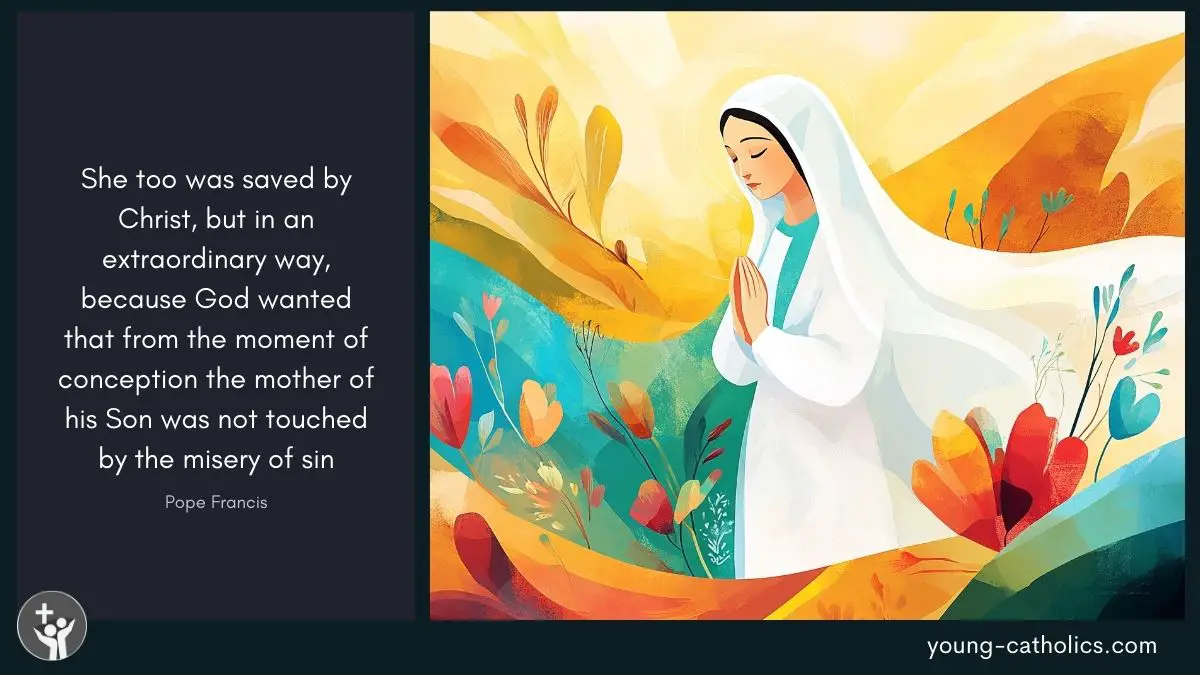
For me, the Immaculate Conception is the feast of ‘passive action,’ the action that functions simply by the transmission through us of divine energy. Purity, in spite of outward appearances, is essentially an active virtue, because it concentrates God in us and on those who are subject to our influence.
Pierre Teilhard de Chardin
In her humility, Mary she knows she receives everything from God. Therefore, free from herself, she is completely turned toward God and others. Mary Immaculate does not look on herself. This is true humility: not looking on oneself, but looking toward God and others.
Pope Francis
Questions and Answers
What day is the Feast of the Immaculate Conception?
It is observed annually on December 8. When December 8 falls on a Sunday, the feast is transferred to Monday December 9.
What is the significance of the Immaculate Conception?
The Immaculate Conception is often misunderstood. It celebrates the conception of Mary, not Jesus. The Catholic Church teaches that through the grace of God, Mary was conceived without the stain of original sin, thus making her a worthy vessel for the Son of God.
Is the Immaculate Conception the same as the Virgin Birth?
No, the Immaculate Conception and the Virgin Birth are two distinct beliefs. The Virgin Birth refers to the belief that Mary conceived Jesus by the power of the Holy Spirit while remaining a virgin.
When was the doctrine of the Immaculate Conception defined?
The doctrine of the Immaculate Conception was officially defined by Pope Pius IX in 1854 through the papal bull “Ineffabilis Deus.”
Why is the Immaculate Conception important?
The Immaculate Conception is important because it highlights Mary’s unique role in salvation history and emphasizes her purity and holiness.
Does the Immaculate Conception mean that Mary did not need a savior?
No, the Immaculate Conception does not mean that Mary did not need a savior. Like all human beings, Mary needed the salvation brought by Jesus Christ. However, she was preserved from original sin from the moment of her conception.
Is the Immaculate Conception mentioned in the Bible?
While the term “Immaculate Conception” is not explicitly mentioned in the Bible, there are biblical passages that allude to Mary’s special role and her being “full of grace.”
Does the Immaculate Conception make Mary divine?
No, the Immaculate Conception does not make Mary divine. Mary remains a human being, but one who was uniquely chosen by God for her role as the mother of Jesus.
Do all Christians believe in the Immaculate Conception?
No, the belief in the Immaculate Conception is primarily held by Catholics. Other Christian denominations may have different interpretations of Mary’s role and her conception.
Can we pray to Mary the Immaculate Conception for intercession?
Yes, Catholics believe in the intercession of Mary. Just as we may ask a friend or family member to pray for us, Catholics believe that Mary can intercede on our behalf before God.
Does the Immaculate Conception diminish the role of Jesus?
No, the Immaculate Conception does not diminish the role of Jesus. Rather, it highlights the unique relationship between Jesus and Mary, emphasizing her role as the mother of the Savior.
Is the Immaculate Conception a dogma of the Catholic Church?
Yes, the Immaculate Conception is a dogma of the Catholic Church. Dogmas are essential teachings that Catholics are required to believe.
How does the Immaculate Conception relate to the Assumption of Mary?
The Immaculate Conception and the Assumption of Mary are closely related. The belief in the Immaculate Conception prepares the way for the Assumption, which is the belief that Mary was taken body and soul into heaven.
Who is the Our Blessed Mother Mary, the Immaculate Conception, the patron saint of?
She is the patroness of the United States.
A Pure Beginning
Mary is the mother of Jesus. She is very important in the Catholic faith. The Immaculate Conception is a teaching about Mary. It means she was free from original sin from the moment she was conceived. This made her pure and holy.
God chose Mary to be the mother of Jesus. Because she was free from sin, she was the perfect choice. The angel Gabriel told Mary about God’s plan. Mary said “Yes” to God and accepted her role. Her obedience and faith show her great love for God.
Catholics celebrate the Feast of the Immaculate Conception on December 8th. This day honors Mary’s pure beginning. It reminds us of her special role in God’s plan. Mary’s life is an example of humility, obedience, and faith. She is a model for all Christians to follow.
Your Turn
Learn more about Mary and the Immaculate Conception. Discover how her life can inspire you. Reflect on her humility, obedience, and faith. Share your thoughts and experiences in the comments. How has Mary’s example helped you in your faith journey? Let’s discuss and grow together.

Leave a Reply